

WHAT WE DO
At Fundación Cerro Guido Conservation we are concerned with conserving the territory's heritage, encompassing two main areas of action: first, the conservation of natural heritage, and second, the preservation of cultural heritage. These two categories are subdivided into areas where we are taking different actions,
here we tell you in more detail:

We carry out conservation, restoration, and rewilding projects.

We train livestock guardian dogs to prevent conflict between ranchers and predators.

We developed an experiment to evaluate the effectiveness of livestock guardian dogs.

We monitor pumas as a key species within the ecosystem, while moving toward a broader understanding of the landscape — developing new initiatives that include the study of guanacos, condors, and other species that are fundamental to the health of the territory.
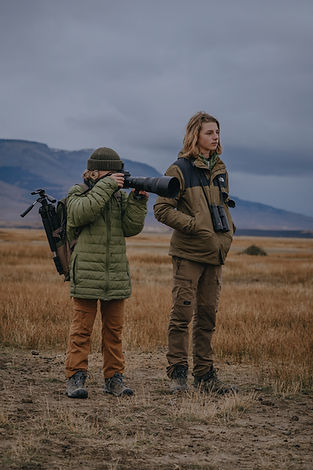
We create educational and awareness experiences for tourists, students, and scientists.

We generate knowledge and collect long-term, practice-based research data.
FOCUS AND AREAS OF ACTION

NATURAL HERITAGE
Cerro Guido stands out for its rich biodiversity and geography characteristic of Patagonia. This environment includes steppes, mountains, and rivers that are home to emblematic species such as the puma (Puma concolor), the guanaco (Lama guanicoe), and the Andean condor (Vultur gryphus), all of which are essential to the trophic chain and the ecological balance of the region.
In addition to its biodiversity and geography, Cerro Guido is an area of great paleontological significance, with dinosaur fossil discoveries that reveal the geological history of the region and its importance in the study of the evolution of life on Earth.
The extreme climate, characterized by strong winds and drastic temperature variations, has shaped a resilient ecosystem in which both wildlife and human activities—especially livestock farming—have developed over centuries.
The Cerro Guido Conservation Foundation is dedicated to preserving this natural heritage through scientific research, species monitoring, and the implementation of conservation practices that promote harmonious coexistence between wildlife and human communities.
The cultural heritage of the region is deeply linked to the history of livestock farming and Patagonian rural life. The figure of the baqueano—a traditional herder and guide of the region—embodies an extensive knowledge of the land and a constant relationship with nature. The customs and traditions of these inhabitants, which have endured for generations, reflect a unique way of life that should be honored.
Livestock farming, as a key cultural activity of these communities, has been both a source of economic livelihood and a defining element of regional identity. However, it has also given rise to challenges, such as conflicts with wildlife species, particularly the puma and the guanaco.
In addition, Cerro Guido contains significant archaeological remains that bear witness to the presence of Indigenous peoples who inhabited these lands long before European colonization. These sites offer a window into the past, showing how early communities interacted with the natural environment.
Local architecture, mainly found in livestock estancias, is another key element of the region’s cultural heritage. Traditional buildings, designed to withstand extreme climatic conditions, stand as testimony to the ingenuity and adaptability of communities living in the harsh Patagonian environment.
The Cerro Guido Conservation Foundation collaborates in the preservation of these structures, keeping local history alive.

CULTURAL HERITAGE
PROJECTS

PUMA PROJECT

Coexistence Model:
Strategies for conflict prevention
Objectives:
(i) To study mechanisms that prevent carnivores from approaching undesired areas, and to evaluate their effectiveness across different fields.
(ii) To continue breeding Great Pyrenees and Maremma sheepdogs, integrating them into flocks as protectors and deterrents against livestock predators.
(iii) To develop capacities and expand livestock management practices, gradually incorporating a more holistic approach.
(iv) To establish a coexistence model between ranching and wildlife that can be replicated in other estancias and territories.

WILDLIFE MONITORING AND RESEARCH

Wildlife Monitoring and Research
Objectives:
(i) To monitor and assess the presence of pumas and other species within the Estancia Cerro Guido territory and the Torres del Paine area, through both direct and indirect observations.
(ii) To maximize the likelihood of obtaining records of pumas (and other species) in order to study their behavior, adaptability to ecosystem changes, and interspecies interactions, among other aspects.
(iii) To produce and collaborate on scientific publications for national and international journals.
(iv) To generate valuable knowledge that supports evidence-based decision-making and contributes to achieving harmonious coexistence among the different actors within the territory.
.jpg)
SCIENTIFIC OUTREACH AND EDUCATION
_e.jpg)
Scientific Outreach and Education
Objectives:
(i) We promote a deeper understanding of biodiversity and coexistence in Patagonia through field-based educational activities, open to the local community, visitors, and students. These experiences aim to spark curiosity, foster respect, and strengthen the connection with the natural environment.
(ii) We encourage active public participation in scientific processes, inviting people to take part in wildlife monitoring activities, workshops, and conservation safaris. In doing so, we strengthen the link between science and society, making knowledge a shared experience.
(iii) We create and share scientific content that is both accessible and rigorous, aiming to inspire informed and engaged participation in the conservation of the territory. We believe that communicating science is also a form of conservation: by bringing knowledge closer, we open the path to change.

HUEMUL PROJECT

Huemul Project
Objectives:
(i) A monitoring system has been established to assess the presence of huemul deer within the Torres del Paine area, prioritizing indirect records and occasional observations.
(ii) Strategies have been designed to maximize the probability of detecting huemul (and other species of interest), in order to study their presence, behavior, and adaptability to ecosystem changes.
(iii) The project seeks to generate information that will allow, in the future, an assessment of the feasibility of a potential huemul reintroduction, including the creation of a rescue and rehabilitation center for this endangered species.

PALEONTOLOGY AND GEOLOGY

Paleontology and Geology in Cerro Guido
Collaborator: Chilean Antarctic Institute (INACH)
Objective:
To make the territory’s paleontological sites visible and accessible to the scientific community, facilitating their research, dissemination, and recognition.
Activities:
(i) Scientific expeditions to carry out geological and paleontological studies.
(ii) Stratigraphic surveying of the area.
(iii) On-site prospecting and identification of fossil material.
(iv) Fossil extraction.

ARCHEOLOGY

Archaeology in Cerro Guido
Collaborator: University of Magallanes (UMAG)
Objective:
To study, make visible, and make accessible the territory’s archaeological sites to the scientific community, facilitating their research, dissemination, and recognition.
Activities:
(i) Scientific expeditions to carry out archaeological studies.
(ii) Data collection and documentation of the area.
(iii) On-site prospecting and identification of archaeological material.
At Fundación Cerro Guido Conservation we are concerned with conserving the territory's heritage, encompassing two main areas of action: first, the conservation of natural heritage, and second, the preservation of cultural heritage. These two categories are subdivided into areas where we are taking different actions,
here we tell you in more detail: